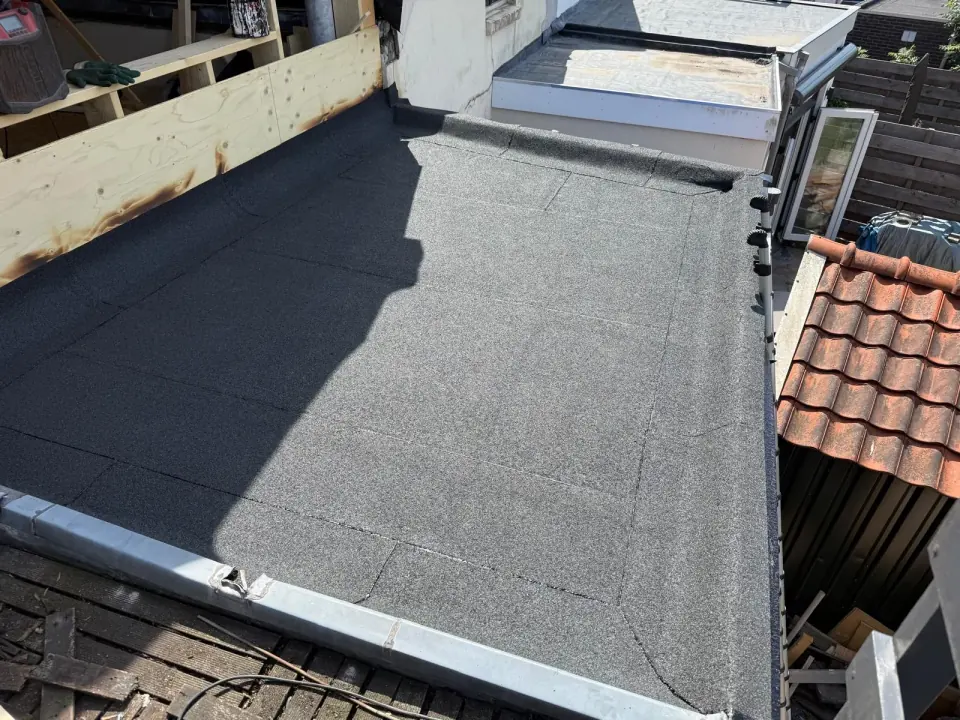
Collect records of the existing roofing layers and earlier work. Ask why retaining the build-up is considered suitable and how moisture, damaged areas or unknown layers will be assessed. Edges, outlets and penetrations should be named in the quotation. Agree when removal may become necessary and how the scope changes would be approved. Keep the final build-up documentation.
Identify the existing system
Collect available information about previous layers, repairs and the substrate. Ask the roofer which parts are known and which are assumptions. The fact that bitumen is visible does not establish the whole roof build-up.
Check beneath the surface
Ask how moisture, damaged areas and uncertain layers will be assessed. The proposal should explain why retaining the existing build-up is suitable. If that cannot be established, discuss what further investigation is needed.
Include edges and penetrations
A new layer affects the relationship with roof edges, upstands and outlets. Ask which details will be adapted or renewed and how they connect to retained components. These details belong in the quotation.
Agree an alternative in advance
Ask under which findings removal becomes necessary and how the revised work will be priced. Confirm who approves a change before it is carried out. A conditional overlay proposal is not an unconditional promise to keep every layer.
Discuss the changed roof build-up
Compare the proposed total build-up with existing levels around drainage and rooflights. Ask which transitions are reused and which need adjustment. A square-metre item alone does not describe this additional detail work.
Keep the assessment and final record
Retain the original findings, agreed exclusions and photographs. At completion, ask for the layers actually installed and any changes made during the work. This helps a future contractor understand what is beneath the surface.